Our recent dive into Machine Head sparked a fascinating debate about the distinction between spike decks and spice decks. Some argued that Machine Head, while not strictly fitting the spike archetype, doesn’t quite qualify as spice either. Personally, I think Machine Head is just a “good” deck. In my opinion, it is nestled comfortably around a 7, perhaps an 8 on a particularly good day, but I can see how it does have characteristics of both categories. It’s a fully powered and highly tuned deck, two clear characteristics of a spike deck. At the same time, it’s a very greedy overall strategy which comes with constraints that necessitate difficult decisions at the cost of staple cards, a characteristic of a spice deck.
The whole buzz about spike and spice decks has really piqued my interest. As I immersed myself further into the complexities and nuances of spike and spice, I became intrigued by the categorization system devised by Wizards of the Coast. Under this framework, players are delineated into three distinct archetypes: Timmy, Johnny, and Spike.
Timmy
Timmy is often hailed as the power player. For him, victory isn’t just about scraping by; he yearns for grand triumphs. Timmy players are drawn to colossal cards with massive effects, anything that grants them the ability to dominate their adversaries. Timmy strives for monumental victories. He isn’t particularly concerned with crafting a finely-tuned and efficient deck; his primary aim is to revel in the enjoyment of the game.
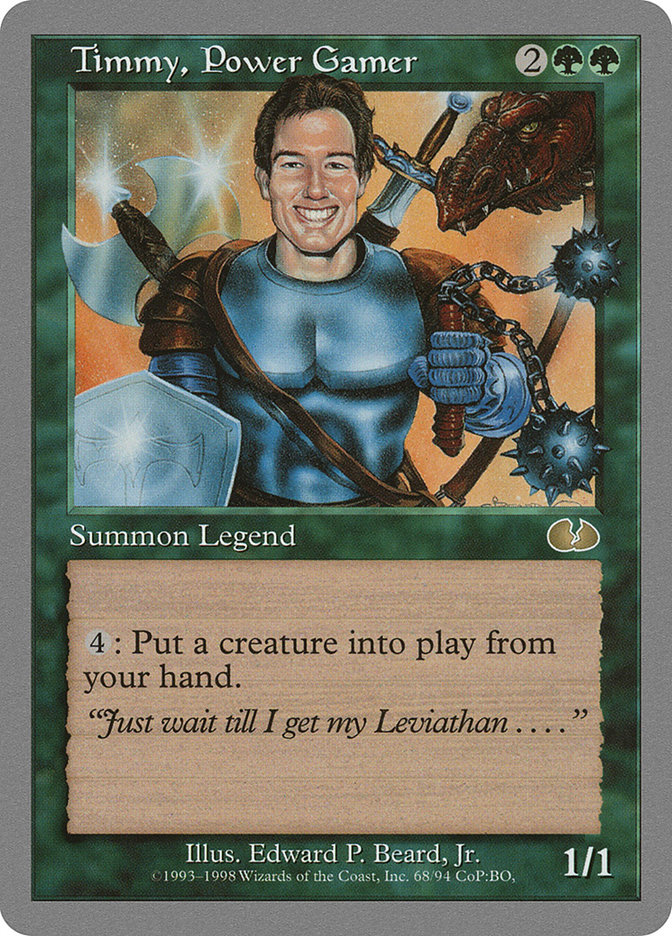
Even if Timmy only secures a few wins, the satisfaction of utterly overpowering his opponent in those games leaves him content. Decks like Reanimator and Eureka are good examples of Timmy strategies.
Johnny
Johnny is frequently labeled as the combo player; they relish in meticulously devising a plan and executing it flawlessly. Johnny players are drawn to niche cards with distinct effects, often building decks around seemingly unplayable cards to showcase their potential. Their primary objective is not always victory; rather, Johnnies seek to express their creativity and individuality through their gameplay. Even if they don’t emerge victorious every time, the opportunity to manifest their unique ideas is what drives them forward. Good examples of Old School Johnny decks are; Tax-Edge, Lich-Mirror and Leprechaun Ward.
Spike
Spike is frequently referred to as the tournament player. Their sole objective is victory, and they will opt for the best deck available to achieve it. Spike players relentlessly seek opportunities to enhance their chances of winning, earning them the reputation as the most competitive archetype. They are drawn to the most efficient cards and decks, meticulously researching which strategies are currently dominant. Spikes will either adopt these powerful decks as they are or analyze and refine them until they reach perfection. Winning and showcasing their prowess as a player are paramount to Spikes. The prime example of a spike deck is The Deck.
A nuanced understanding
Now that we have a better understanding of the three distinct player archetypes – Timmy, Johnny, and Spike – it’s clear that categorizing decks into spice and spike can still be quite challenging. While each archetype has its own preferences and motivations, there’s often overlap when it comes to deck choices. Translating the concepts of spice and spike into tangible deck choices can be a nuanced endeavor. In the case of Machine Head, it’s evident that both Johnny and Timmy players might find appeal in its blend of power and creativity. However, for Spike players, who prioritize winning above all else, the inherent risks and constraints of Machine Head may make it less appealing. Thus, with our newfound understanding of player archetypes, the categorization of Machine Head remains a complex and subjective matter, but it’s definitely not a spike deck.
What is it?
Spice essentially denotes creativity and intrigue. It can refer to “spicy jank,” representing unconventional yet captivating decks that are not highly competitive but offer immense fun during play. Additionally, spice can also denote innovative, competitively optimal builds. However, if the latter gains widespread recognition for its effectiveness, it risks losing its spicy essence and transitioning into the mainstream. I believe Machine Head could fit into this latter category.
It’s important to note that opinions on whether Machine Head still qualifies as spice may vary among players. While some may argue that its power level and have propelled it into the realm of mainstream decks, others may contend that its inherent creativity and uniqueness still align it more closely with the spice category.
Final thoughts
The distinction between spice and spike decks, as well as the nuances of player archetypes, offer endless opportunities for exploration and discussion. Whether you find yourself drawn to the thrill of competitive victory, the allure of creative expression, or the sheer joy of immersive gameplay, it’s clear that Magic encompasses a rich tapestry of experiences for players of all types. Categorizing decks can provide insights into different playstyles and strategies, but ultimately, the most important aspect of Magic: The Gathering is having fun. Players should feel free to play the decks they enjoy and find most entertaining, regardless of how they fit into specific categories. Whether you’re brewing up your own unique creation or playing a well-established archetype, the primary goal should always be to have a great time and enjoy the game with friends and fellow players. So, while categorizing decks can be interesting for discussion and analysis, it’s not necessary for everyone to adhere to these classifications in their gameplay. Just play what you love and have fun!




 The Edge-Man
Leave a comment